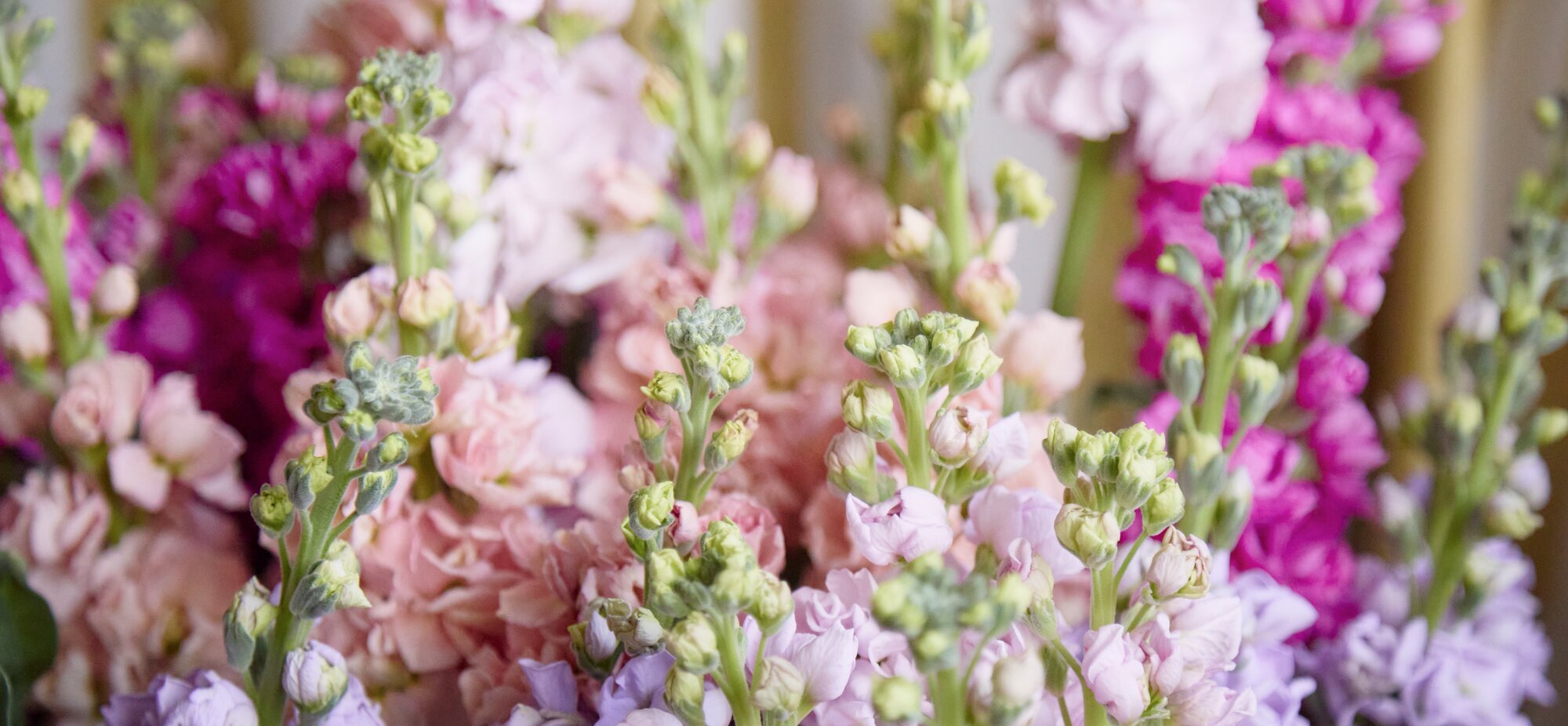

Scented Stocks for Spring
Freddie’s Ultimate Care & Arranging Guide
Our blooming sensations, the Scented Stocks, are a Freddie’s favourite. These tall, sculptural stems with ruffling clusters of petals truly signify spring for us and add a lovely bit of texture, charm, and softness to an arrangement.

Botany: What is Matthiola Incana?
You wouldn’t know it to look at them, but stocks, also known as the Gillyflower, are part of the Brassicaceae family, aka the cabbage family. Considering other relatives include mustard, broccoli, and turnips, we think stocks are definitely the prettiest of the bunch, known for their abundance of tight, ruffled blooms on strong, upright stems.
Originally native to South Africa and some parts of the Mediterranean, they were first brought over to Europe by the Italian botanist and doctor named Pietro Andrea Mattioli – who is said to have cultivated this bloom because he believed it possessed medicinal values. This is also how they got their botanical name Matthiola Incana.
While there’s many different types of stocks, Matthiola Incana are used in floristry for their ornamental beauty and are often heavily scented. Other varieties may lend themselves more to be planted in gardens - Matthiola bicornis, also known as night-scented stocks, for instance, is often planted near seating areas for the lovely scent they release in the evening.
What’s the Difference Between Stocks and Snapdragons?
Stocks and snapdragons may easily be confused from a distance as both are tall stems with multiple flower heads at the top and come in a similar colour palette. At a closer look, however, they’ve got some key differences:
- Flower shape: Snapdragons have the infamously dragon-head-shaped blooms after which they’re named, while stocks feature tighter, more ruffled blooms.
- Fragrance: Stocks are often heavily scented, from sweet to more peppery notes, while snapdragons don’t have a strong natural aroma.
Stem structure: While both are tall, snapdragons tend to be stiffer and more durable, while stocks are a little more delicate, allowing them to easily be adjusted in an arrangement.

How to Use Stocks in Arrangements
Stock flowers signify the awakening of spring for us, perfectly paired with pastel tones, lush greens, or vibrant pops of colour. Because they’re tall and stand upright, they’re the perfect sculptural focal points for showstopping arrangements, adding height and drama.
They also look wonderful cut down into smaller arrangements or bud vases. You can then dot around the house for some extra floral flair and pockets of lovely fragrance. Their architectural dazzle is also wonderful for creating extravagant flower frog displays.
To truly make the very most of them, know that stocks air-dry beautifully when they are tied loosely and hung upside down in a warm, well-ventilated area. If they’re dried fast enough, their fresh scent will be preserved along with them. Check out our guide on preserving flowers for the best practices on drying flowers.
Florist Care: Pro Tips on Keeping Stocks Happy
As with most flowers, remember that the right prep is key to making the most of your arrangement and extending your stems’ vase life.
How to Trim Woody Flower Stems
As stocks feature quite sturdy stems, make sure to use sharp secateurs or a sharp knife that won’t squash them. Re-cut them at an angle to increase the surface area for water absorption and to make sure they don’t sit flat on the bottom of your vase
How to Prevent Vase Water from Smelling
Stocks release a lot into the water, so to prevent bacteria build-up, make sure to remove your stocks’ lower leaves so none are below the vase neckline, regularly change your water, and add flower food. This helps with nourishing your stocks and keeping your water clean.
How long do stock flowers last in a vase?
Stocks can last happily in a vase for up to two weeks, given the right preparation and care. Our pro tip is to gently remove the lower flowers of your stocks once they have bloomed. This helps prolong the life of the stem and encourage more blooming at the top.
Are Stocks Safe for Pets?
Yes! Stocks are non-toxic for both cats and dogs, so you can safely display them around your furry friends. The ASPCA has a handy list you can check if you’re ever unsure whether a certain plant or flower is safe for your animals to have around your house.
What Freddie’s Arrangements Do Stocks Feature in?
These delightful blooms have made their way into a selection of our upcoming arrangements, so you can enjoy them around your house. Find your favourite here:

Floriography: What do Stock flowers symbolise?
Placed in an arrangement, these flowers overflow with charm and beauty – and that’s pretty much exactly what they mean in the Victorian Language of Flowers, Floriography. Individually the colours mean different things but collectively they symbolise overflowing affection and contentment.
Beyond that, stockflowers also made their way into one of the Bard’s plays. Shakespeare praised their beauty in The Winter’s Tale, with Perdita’s line: “The fairest flowers of the season/Are our carnations and streak’d gillyvors.” And we definitely have to agree.


Up next...
Behind the Scenes for Sense & Sensibility
We couldn’t resist partnering with Universal to create two limited-edition arrangements to celebrate the release of Sense & Sensibility.
The Art in Everyday Moments with Natalia Bagniewska
We caught up with Natalia Bagniewska on all things art, inspiration, and what the new season means to her.